
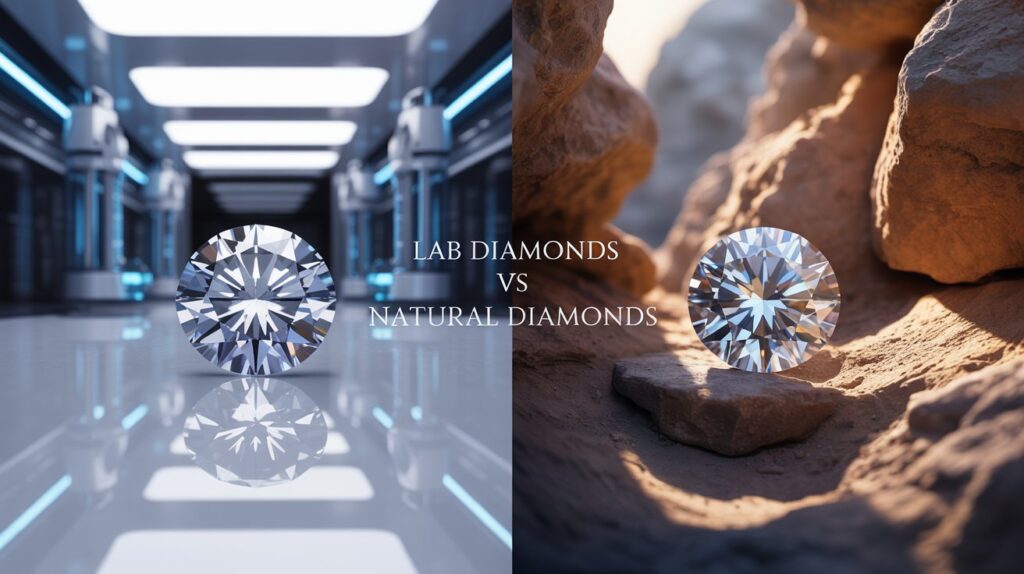
The debate between lab grown diamonds vs natural diamonds is not one of real versus fake; it is one of origin versus innovation. For centuries, diamonds—gems of unparalleled brilliance and durability—were solely geological wonders. Today, cutting-edge science has made it possible to replicate that process, leading to two distinct diamond categories in the market.
This definitive expert guide cuts through the confusion, providing a factual, chemical, and ethical breakdown to help you make an informed choice. The only thing separating these two gems is billions of years.
Scientific Identity: Why Both Are 100% Real Diamonds
The most crucial fact to understand is that lab grown diamonds are real diamonds. This statement is based on verifiable science and recognized by major gemological institutes worldwide.
Identical Chemical and Physical Composition
Both natural diamonds and lab grown diamonds share the exact same chemical, physical, and optical properties:
- Chemical Formula: Both are pure carbon (C) atoms arranged in the same cubic crystal structure.
- Hardness: Both score a perfect 10 on the Mohs hardness scale, making them the hardest material known on Earth and equally durable for everyday wear.
- Optics: Both exhibit the same fire, brilliance, and scintillation (the way a diamond handles and reflects light).
- Testing: Lab grown diamonds will pass all conventional diamond testing tools that measure thermal or electrical conductivity, as their atomic structure is identical to that of mined diamonds.
The only difference, often undetectable to the naked eye and sometimes even to experienced jewelers without specialized equipment, lies in the trace elements and growth patterns. Natural diamonds often contain traces of nitrogen, while lab diamonds (particularly those made by the CVD method) are often Type IIa, a chemically purer class.
How Specialists Tell Them Apart
Specialists rely on advanced gemological tools, such as infrared and ultraviolet spectroscopy, to identify subtle non-diamond carbon phases or unique internal graining patterns left by the rapid, controlled growth process in the lab. This confirmation is recorded on their certification reports.
Origin Story: Time vs. Technology (HPHT vs CVD)
The true divergence between lab grown diamonds and natural diamonds is the method and timeline of their creation.
Natural Diamond Formation
Natural diamonds are the result of geologic chaos. They are formed deep within the Earth’s mantle, roughly 100 miles below the surface, where immense heat and pressure act on carbon for anywhere from one billion to 3.5 billion years. They are brought to the surface through rare, violent deep-source volcanic eruptions via kimberlite pipes, where they are eventually extracted through intensive mining.
Lab Grown Diamond Creation
Lab grown diamonds replicate this geological feat in a controlled environment over a period of mere weeks. The two primary, high-tech methods are:
- High-Pressure/High-Temperature (HPHT) : This method precisely mimics the Earth’s mantle, placing a carbon source and a tiny diamond seed into a specialized press and applying extreme heat and crushing force.
- Chemical Vapor Deposition (CVD) : This technique involves placing the seed in a vacuum chamber, introducing carbon-rich gases (like methane), and breaking them down into plasma using microwave technology. Carbon atoms precipitate and bond to the seed, growing the diamond layer by layer.
Both methods produce the exact same crystalline structure, but the speed and control afforded by technology dramatically reshape the pricing and supply chain.
The Core Differentiators: Ethics, Price, and Environment
For the consumer making a purchase, the decision rests on three practical factors: Ethics, Affordability, and Environmental Impact.
Ethics and Transparency (Conflict-Free vs. Supply Chain Complexity)
- Lab Grown Advantage (Ethical Jewelry): Lab diamonds are created in controlled, traceable facilities. This guarantees a conflict-free diamond and provides total transparency into their origin, aligning with the growing demand for ethical jewelry.
- Natural Diamond Consideration: While certifications like the Kimberley Process aim to prevent the trade of conflict diamonds, the natural supply chain remains complex and multi-layered. Concerns regarding land displacement and labor practices in certain regions persist, leading many consumers to favor the guaranteed ethical origin of lab stones.
Price and Value (Affordable Luxury vs. Rarity Premium)
- Lab Grown Advantage (Affordable Luxury): Due to the speed and efficiency of creation, the lab diamond price is significantly lower—often 60% to 85% less than a natural diamond of comparable quality (based on the 4Cs). This allows buyers to choose a substantially larger or higher-quality certified lab diamond for their budget.
- Natural Diamond Consideration: Natural stones command a premium based on their rarity and the huge costs associated with geological exploration, mining, and complex distribution.
Environmental Impact (Land Disruption vs. Energy Consumption)
- Natural Diamond Consideration: Diamond mining involves intense excavation, leading to significant land and habitat disruption, soil erosion, and substantial water use.
- Lab Grown Advantage (Sustainable Jewelry): Lab production drastically reduces the physical footprint, using minimal land and water. While the creation process is energy-intensive, the carbon footprint of a lab diamond can be significantly lower than a mined one, especially when the producing lab utilizes renewable energy sources to fuel its operation.
The Buying Decision: Certification and Assurance
Regardless of origin, a diamond’s quality is defined by the 4Cs (Cut, Color, Clarity, Carat). Both types are rigorously graded by independent authorities.
- Certification: Reputable lab grown diamonds and natural diamonds alike receive grading reports from globally recognized institutes like IGI and GIA. These reports verify the 4Cs and, crucially, explicitly state whether the stone is natural or laboratory grown.
- Durability: Since the chemical structure is identical, both stones are equally hard and durable, making either option a lifetime purchase, perfect for lab grown diamond wedding rings or high-end everyday diamonds.
Ultimately, the choice between lab grown vs natural diamonds comes down to personal values: Do you prioritize the rarity and history of a natural stone, or the affordability, size, and guaranteed ethical origin of an identical, high-tech diamond?
The SHAMBH Assurance
SHAMBH is more than just a diamond supplier; we are expert wholesalers of loose diamonds and master manufacturers, controlling the entire supply chain of the stone. This direct involvement eliminates unnecessary market layers, guaranteeing the highest quality and transparent value for all our clients and partners. We handle everything from sourcing the perfect certified lab diamond to realizing intricate designs through our advanced manufacturing capabilities.
We invite you to partner with a source that embodies both technical excellence and transparent value, securing your purchase with the confidence that only a direct manufacturer can provide.
Connect with SHAMBH : Your Source for Certified, Custom Diamond Jewelry
Our core expertise is in transforming raw brilliance into final, perfect pieces through our specialized manufacturing services.
- Wholesale & Sourcing: As a leading wholesaler of loose diamonds, connect with us to source certified, high-carat stones in any quality or volume.
- Bespoke Manufacturing (MTO): Realize your unique design with our custom diamond jewelry (Made-To-Order – MTO) services. We specialize in bringing intricate, personalized designs to life with impeccable craftsmanship.
- Direct Access Advantage: Partner with Desai to gain direct access to manufacturer pricing and deep product expertise.
- Inquire Now: Contact our diamond specialists today to discuss your specific requirements or start your custom project.